Beaten for Truth 2.0: What It Means to Be a Journalist in Georgia Today
- Luka tsereteli
- Sep 25
- 7 min read

Growing Up in a City of Protests
I grew up in Tbilisi, and for as long as I can remember, protests were part of life. My earliest “protest memory” was actually inside my mother’s womb—she carried me to demonstrations against President Eduard Shevardnadze.
As a child, I remember chanting “Misha, gadadeki!” (“Misha, resign!”) during the rallies against President Mikheil Saakashvili. Later, I stood on Rustaveli Avenue during the Bassiani protests when youth clashed with the state over freedom, and the “Nu momklav” protests after two young boys were murdered while their killers walked free.
I remember 2019 too—when Russian MP Sergey Gavrilov dared to sit in the chair of the Georgian parliament speaker. That night, Georgian democracy trembled, and so did we. Tear gas suffocated not just the protesters but also the reporters, who choked live on air.
Through all this, I learned that being a journalist in Georgia doesn’t just mean holding a microphone. It means holding your ground, even when police batons are aimed at your head.


The Russian Law: When Everything Escalated
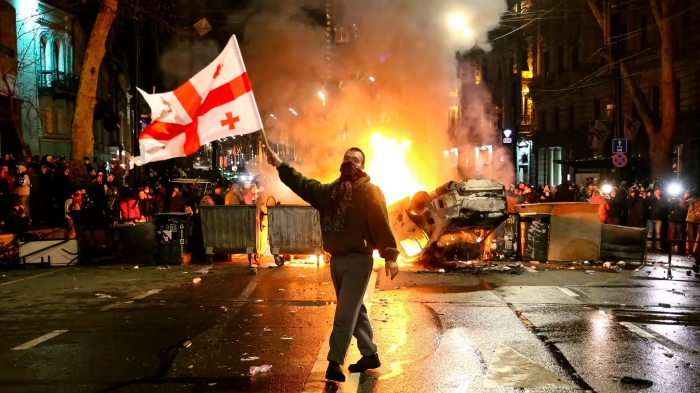
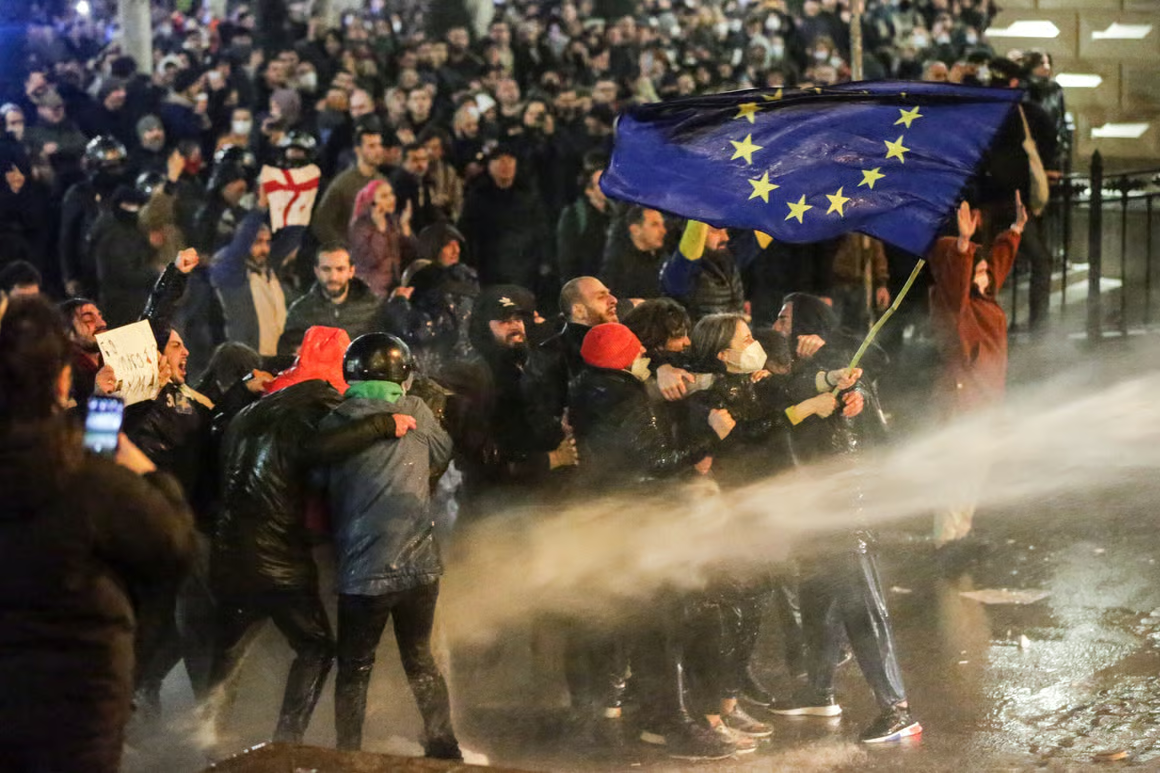
When the so-called “Russian Law” was first introduced in March 2023, the country exploded. It was a direct copy-paste of Putin’s playbook: force media and NGOs that receive more than 20% of funding from abroad to register as “foreign agents.”
In Russia, this law silenced civil society.
In Georgia, it sparked one of the largest protest waves since independence.
I was in Kutaisi at the time, covering local demonstrations for JSN Media, the startup I co-founded in 2021. But after watching the brutal crackdown in Tbilisi on livestream—reporters being dragged, protesters being clubbed—I couldn’t stay away.
In the middle of the night, I packed my bag. With no buses or trains, I begged my friend to drive me to the airport, hoping to hitch a ride. By pure chance, a taxi driver overheard me and offered to take me all the way to Tbilisi—for the price of a minibus ticket. Suspicious at first, I accepted. That ride became my road back into history.
By morning, I was in front of parliament, camera in hand, adrenaline coursing through me. For a brief moment, when Georgian Dream withdrew the bill, we believed we had won. We thought they would never dare bring it back. But that illusion didn’t last.
Between Two Waves: Beaten for Covering an Eviction
Repression against journalists didn’t pause between the waves of the Russian Law.
I’ll never forget one day in 2023, when my cameraman and I were covering the eviction of a family who had been the victims of a corrupt private lender scam.
We weren’t protesters—we were there as journalists, documenting how yet another Georgian family was being thrown out of their home by force. Still, the enforcement police turned their brutality on us. We were beaten, shoved to the ground, and humiliated.
That moment taught me something chilling: in Georgia, violence against journalists is not just about controlling crowds. It’s a systemic weapon—used anytime, anywhere, when someone in power doesn’t want the story told.
I actually wrote a blog about the story - It's a first chapter of this article: Beaten for the Truth: My Story as a Journalist in Georgia

The Numbers: Brutality in Figures
According to monitoring groups (TI Georgia, HRIDC, IFJ, Media Advocacy Coalition):
First wave (March 2023): At least 30 journalists injured in clashes.
Between waves (2023–2024): Dozens more harassed, beaten, or had their equipment destroyed while covering evictions, corruption cases, or smaller protests.
Second wave (2024–2025): Over 46 journalists attacked, including pepper-spraying, detentions, beatings, and deliberate targeting.
Total up to September 2025: More than 70 confirmed attacks on journalists.
The true number is likely higher—many don’t report for fear of retaliation.

During that wave, when the “foreign agents law” was first introduced, violence against journalists in Tbilisi was already extreme. Here are five of the worst documented cases from that period:
Five Worst Cases — First Wave of Russian Law Protests (March 2023)
Name | Media / Outlet | What Happened | Injuries / Damage |
Nika Oboladze | TV Pirveli | Beaten by riot police while livestreaming; police used shields and batons to block his camera. | Sustained head injuries and heavy bruising. |
Mariam Nikuradze | OC Media | Hit by a rubber bullet while covering clashes; despite wearing a press vest, she was targeted. | Required medical care for leg injury. |
Levan Karumidze | Tabula TV cameraman | Dragged by several officers while filming; his camera was broken. | Shoulder injury; equipment destroyed. |
Irakli Gedenidze | Photographer, OC Media contributor | Pushed violently by riot police, then hit with a baton. | Arm injury and camera lens shattered. |
Tamar Svanidze | Freelance journalist | Pepper-sprayed directly in the face while filming arrests. | Severe eye irritation; temporary vision problems. |
This shows that violence against media didn’t start in 2024–2025 — it was already entrenched back in the first wave, with journalists beaten, shot with rubber bullets, pepper-sprayed, and having their equipment destroyed.
My Own Assaults: When the Police Turned on Me
By the second wave in 2024, I was working in investigative journalism and thought I knew how to protect myself. I had a helmet, goggles, gas mask.
It didn’t matter.
I was dragged and kicked as I filmed officers beating protesters.
One officer kicked me down even as I shouted, “I am a journalist!”
Tear gas seared my lungs until I thought I’d suffocate beneath the stampede.
For 48 hours, I didn’t go home—I reported nonstop in the freezing rain. The streets felt like a movie set staged for tragedy: police lined up along narrow alleys, crackdowns timed like theatre, violence rehearsed until perfect.


Five Worst Cases (2024-2025)
Name | Media / Outlet | When | What Happened | Health / Damage / Equipment Loss | ||
Guram Rogava (Formula TV) | Formula TV | November 28-29, 2024 | While reporting live, he was repeatedly punched in the head by riot police and knocked to the curb. The attack was caught on video. | Fractured bones in face and neck; hospitalised. | ||
Aleksandre Keshelashvili (Publika.ge) | Publika.ge outlet | November 28–30, 2024 | Beaten by three or more riot police officers. He was struck in the head, kicked after falling, and had his cameras taken. | Broken nose; required hospital surgery; lost or had damaged two cameras confiscated. | ||
Ana Mskhaladze (Publika.ge) | November 29–30, 2024 | While filming detentions, she was struck in the head by a DST officer. Her phone dropped; when she tried to retrieve it, she was hit again. | Head injury; phone confiscated; suffering from concussion / trauma. | |||
Giorgi Gamgebeli (Freelance photographer) | Freelance / independent | November 30, 2024 | Attacked by police who beat, dragged, kicked him over several minutes. His camera was seized. | Severely sprained leg; split lip; equipment damaged or taken. | ||
Nutsa Bakhutashvili (Formula TV) | Formula TV | November 30, 2024 | Struck on the back by officers during protest coverage; chased. | Sustained concussion; trauma from impact; possible longer recovery. | ||

Aleksandre Keshelashvili – Publika.ge
During the first wave of Russian Law protests in March 2023, Aleksandre was violently attacked by multiple riot police officers while covering demonstrations in Tbilisi. Struck in the head and kicked after falling, he was left with a broken nose and heavy bruising. His camera was also damaged in the assault, highlighting the risks journalists face while reporting from the frontlines of civil unrest.
"Video footage showed the moment RFE/RL journalist Davit Tsangareli was attacked while reporting live from the Georgian capital, Tbilisi, early on November 29. He was covering protests after the ruling Georgian Dream party announced it was suspending EU accession negotiations until 2028" - www.rferl.org.
The Night Guram Rogava Fell
The moment that broke me came when Formula TV’s Guram Rogava was struck in the head by a special forces officer on live TV.
I had four live streams open on my laptop. When he collapsed unconscious, I screamed at the screen: “HELP! HELP! HELP!”
Another journalist, Nanuka Qajaia, rushed to him on air. The entire country held its breath.
I was in Prague at the time, volunteering. Later that night, I stood on Charles Bridge with a Georgian journalist friend. We cried together. For others, Charles Bridge is a place of romance. For me, it will always be the place where I grieved for my colleague’s broken skull.
Why This Fight Matters
The Russian Law is not just paperwork. It is the weaponization of bureaucracy against truth. It seeks to:
Starve media of funding.
Criminalize NGOs and civil society.
Turn journalists into “agents.”
Yet despite this, Georgian journalists keep working—without salaries, without grants, sometimes without safety, but never without courage.
People like Mzia Amaglobeli, founder of Batumelebi/Netgazeti, who remains jailed on false charges. People who show up with a camera even when it means getting beaten.



What Journalism Must Become
We can’t just resist. We must transform:
Put the audience first → beyond ego, journalism is public service.
Be transparent → open about values.
Use new forms of distribution → not just text, but video, short-form, podcasts, interactive tools.
Embrace technology, don’t fear it → AI, automation, and digital tools can help keep journalism alive under repression.
This is not just Georgia’s story. It’s a warning to the world: when you silence journalists, you silence the people.
Final word
The story of Georgian journalists during the Russian Law protests is more than a list of attacks, injuries, and damaged cameras. It is a testament to courage, resilience, and the unyielding commitment to truth. From the first wave in March 2023 to the ongoing struggles in 2025, journalists have risked their safety to ensure that the public sees what is happening on the streets, in parliament, and in their communities.
These attacks are not just physical—they are attacks on democracy, on the free flow of information, and on the very fabric of civil society. Yet, despite intimidation, threats, and violence, the press continues to work. From Guram Rogava’s live broadcast under assault to reporters like myself who stood in freezing streets covering evictions and protests, the courage of Georgian journalists demonstrates the power of standing for truth, even when the cost is personal.
This story is a call to action: to support independent media, to demand accountability for violence against journalists, and to remember that press freedom is not a luxury—it is the cornerstone of a free society. In the face of brutality, the spirit of Georgian journalism endures. And as long as we continue to report, to witness, and to speak, hope for a freer, more transparent Georgia remains alive.


Comments