What Will People Say?
- Luka tsereteli
- Sep 9
- 4 min read

Updated: Sep 11
Since childhood, my world was defined by a single mission: to help my homeland reclaim the territories occupied by Russia. I understood that the land itself was not the only value we had lost; we had lost the homes of hundreds of thousands of displaced people. This was my driving force. But growing up in the ghetto meant confronting a different kind of occupation every day—one of a criminal mentality, with no sense of law or order.
The boys on my street were rough, aggressive products of parents who never grasped the immense responsibility of having children. They assaulted people simply because they felt like it—arrogant, uneducated, and cruel. I tell you this to explain the world I had to navigate, a world without dignity or morality. And no, you cannot excuse them as children, because today, they are the exact same men.
My only escape was television. The only time I felt safe or understood was when I was bathed in the glow of the screen. I vividly remember a major Georgian channel that broadcast a news program anchored by 14-year-olds, reporting on topics relevant to young viewers. Even as a child, I knew I had stories to tell. I saw the power and influence that media held in early 2000s Georgia, and I knew it was my calling.
Breaking into the world of broadcasting, however, is a monumental task. It is a sealed-off industry where you cannot get in unless you are a cousin or a close friend of someone already established. But I refused to give up. I grinded, I worked, and I spent an awful amount of time on the sets of television shows, often starving because my family couldn't, or wouldn't, provide me with basic expense money.
While my classmates were talking about music, kissing boys and girls, and chasing trends, my world was entirely different. I was discussing the national budget, asking when a coworker would return from her maternity leave, and listing the names of the president, prime minister, and members of parliament. I had to face adult challenges as a teenager, demanding that my older colleagues treat me as an equal with the same understanding of the world. I was worried about the direction of the country, because I saw that its future was in the hands of my generation—an age group completely ignored by politicians, the media, and society at large.
The rot in Georgia ran deep. I can’t properly explain how horrifically children’s rights were, and are, violated, and how little anyone seems to care. The parents, for the most part, are consumed by a single, paralyzing concern: “What will people say?”
This question, this cultural disease, has led to terrible consequences. It is the reason Georgia today is a failing state. A nation that survived centuries of colonization is now being mentally, culturally, and economically destroyed by a Russian puppet regime: the “Georgian Dream” party. I can assure you, their vision is no dream for the Georgian people. There is nothing Georgian in their party, only the rotten mentality of Russian colonialism that whispers, “I don’t care about others; only my well-being is important.”
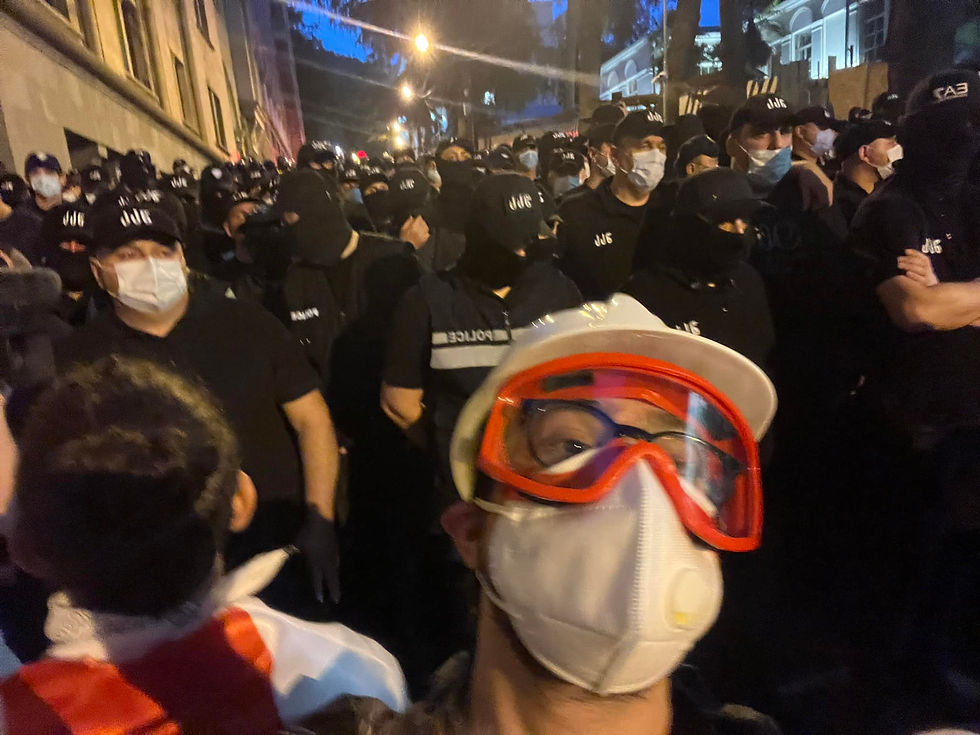
The Georgian Dream became the enemy of the people, and the enemy of my profession. My career, built with sweat and literal blood—from being beaten by police and special forces at protests—was destroyed by their infamous “Russian Law,” the first major public announcement of their dictatorship.
Journalism cannot exist in a vacuum. It requires funding. The regime systematically destroyed the advertisement market, pressuring businesses to abandon opposition media and instead support state-controlled channels. Even as this happened, the professional journalists in the Georgian media field acted selfishly. They failed to defend the most sacred principle of their craft: to put the audience first. Trapped by ego, they failed to adapt and fight back. One by one, independent media outlets lost their power, closed down, or were taken over.
Some might say these journalists fought bravely, but they are wrong. These so-called professionals criticized the government on air, then maintained their close personal friendships with the very people who were silencing them. They showed they were not real journalists with values, but wannabes who simply thought working in TV was cool. For me, being a journalist is a sacred duty: to protect the truth, to serve the audience, and to fight the powers that want you silenced. They failed.
Eventually, the regime, led by the oligarch Bidzina Ivanishvili, murdered independent media and civil society. Their violence against the Georgian people escalated to levels of brutality we had never seen before.
If Georgians were not so obsessed with “What will people say?”, our reality would be different. We would fight for our values. We wouldn't care if our uneducated, pro-Russian neighbor was upset by our stance. We would care more about the people whose happiness, security, and right to live were being stolen. This horrible question led to our downfall.
Nepotism and sycophancy are common arts in Georgia. This culture of corruption, present not just in government but in society itself, created unequal opportunities. Many young people simply got out, starting new lives abroad without a care for the homeland they left behind. Others, like me, stayed to fight. I attended every protest since I was a child. I, too, needed a break and tried to escape, but watching from afar as the government brutalized my people drove me mad. I came back.
After countless attempts to make a difference, I finally realized the truth: the core problem isn't the Georgian Dream. It is the level of ignorance that has consumed the Georgian people, a direct legacy of the Soviet Union's bloody 70-year colonial rule, which systematically exterminated our nation’s intellectual elite.
That is why we need independent media. That is why we need true journalists. We need them to guide us, to mirror our reality, to be a light in the darkness, and to lead us to the future that everyone deserves.
So, the next time you find yourself asking, “What will people say?”—stop. Think again. Remember what happened to a nation that had the chance to be strong and happy, but failed because that was the only question on its mind.


Comments